
LEAF’s (Linking Environment And Farming) vision is a global farming and food system that delivers climate positive action, builds resilience and diversity, and enriches our food, farms, the environment and society. We see this being delivered through more integrated, regenerative, circular approaches to farming. The industry already has many of the building blocks to support such a vision, but scalability, speed and collaboration at a new level is needed. Striving for meaningful change needs to be underpinned by science-based targets, new technology and innovation and crucially, working alongside more nature-based solutions. Peer to peer learning, through channels such as the LEAF Network of Demonstration Farms and world leading Innovation Centres, creating the market pull through LEAF Marque certification, educating and connecting young people and the wider public out on the farm, such as through ‘Open Farm Sunday’ – all these need to work together to help transform our farming and food systems. We need ambition, leadership, belief and a practical ‘can-do’ approach to change, not only looking to achieve Net Carbon Zero, but also to enrich our environment, habitats and nature whilst ensuring profitable businesses and an actively connected society. Now is the time for change!
‘Farm of the Future’ – A Vision
Caroline Drummond MBE, Chief Executive LEAF
Agriculture, both in the UK and globally, faces a significant period of change over the next two decades – not least through the ‘threat multiplier’ effects of climate change, turning what were often regarded as 1 in 100-year risk predictions into more regular and sometimes extreme events, including flooding, drought and pest inundations. This is in addition to the other challenges that farmers have to manage – many of which lie outside of their control.
In addition to climatic uncertainties, UK farmers and land managers face other issues: a new subsidy/grant regime (largely as a result of Brexit and changing trading conditions); supply chain adjustments to meet new consumer demands; multiple policy and regulation changes; labour and skills shortages; market fluctuations – and unexpected crises such as the Covid-19 pandemic. With a reputation for resilience, farmers, land managers and rural communities tend to adopt a long term (multi-generational) view of the future.
Farming activity covers some 17.4 million hectares (ha) (43 million acres) occupying around 71% of the UK landmass (see Figure 1). As such, it constitutes a vital part of the UK’s rural, agri-food and bioresource economies. Defra estimates that UK farming produced a total income of £4.1 billion in 2020. Some 219,000 UK agricultural holdings (65% of which are under 50 ha) provide 64% of the nation’s food.
Agricultural land use in the UK, 2018
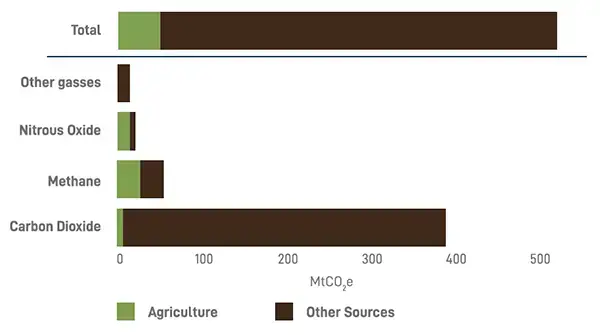
The National Farmers Union (NFU) reported in 20193 that greenhouse gas (GHG) emissions from UK farms amounted to 45.4 million tonnes of carbon dioxide equivalent (CO2e) in 2018 – about 10% of the country’s total emissions.
In contrast to other industrial sectors, only 1% of the UK’s CO2 emissions are from agriculture (mainly from fuel and energy use). However, farming is responsible for around 70% of the UK’s nitrous oxide (N2O) and 50% methane (CH4) emissions produced from fertilisers and grazing ruminant livestock, respectively4. Taken together, agriculture accounts for approximately 10% of the UK’s CO2e emissions.
UK Greenhouse Gas Emissions (2017) in CO2 Equivalents
Although not directly a greenhouse gas, agriculture is also responsible for 88% of the UK’s ammonia emissions5, produced when organic fertilisers (e.g. slurry, manure, sewage sludge, compost, digestate) come into contact with air (wind) and warmth – and when organic and inorganic fertilisers are spread.
Ammonia emissions adversely affect the quality of air, soil, water, ecosystems and biodiversity. Whilst agriculture urgently needs to address its emissions, it has the land area to be able to curb its emissions and sequester more carbon through improved nature-friendly farming practices. Farms are also able to reduce their reliance on fossil fuels by generating various forms of renewable energy. Farming is therefore a key part of owning, framing and claiming the climate solution for rural Britain.
Following withdrawal from the European Union, UK farmers are moving away from a 40-year-old system of top-down area-based subsidy under the Common Agricultural Policy (CAP) and towards different ‘post-Brexit’ agricultural policies covering the devolved regions of Scotland, Wales and Northern Ireland – for example, the Environmental Land Management (ELM) scheme which now applies in England.
This policy shift is an opportunity to drive more agro-ecological, regenerative farming and nature-based solutions on diverse types of farmed land, placing carbon sequestration and carbon reduction at the heart of future plans for farming, land management and the evolving food supply chain.
Although the impact of this transition will be significant, there is as yet little clarity around what the potential income benefits for agricultural businesses might be, making future investment decisions, particularly those around decarbonisation, even more challenging.
Farm business viability is key to farming’s critical functions in providing rural livelihoods, managing the environment and meeting emerging market demands. The core economic role of farming is to harness natural resources and to do so, where possible, at a commercial profit.
However, Defra report that between 2015 and 2018, only the top 25% of UK farm businesses made a clear profit from agricultural activity alone. Many others made little or no profit from their core agricultural activities – relying on additional income from farm or environmental diversification, along with the contribution from direct EU payment subsidies.
It is estimated that 42% of UK farms will be loss-making as a result of the closure of the Basic Payment Scheme, necessitating cost cutting by 10% to compensate6. It is yet to be revealed what the level of support will be from the new agriculture support schemes across the UK. The nature of farm businesses is that they are ‘price takers’ (with limited ability to influence the value of their output) unless they sell to customers directly, e.g. on-line or at markets and fairs.
There is consensus that British farmers produce food to some of the highest standards of hygiene, animal welfare and environmental protection in the world7 8. As such, UK farms are well positioned to address the widening global demand for premium sustainably produced products.
Such opportunities are even more relevant following the UK’s exit from the EU, with opportunities for farmers and processors to be innovative in meeting demands from new international markets.
It is vital to ensure that post-Brexit trade deals on food imports do not disadvantage UK agriculture in favour of cheap food produced to lesser welfare and environmental protection standards.
There is no doubt that over the next decade and beyond, farm businesses, operating within an ever-diversifying rural economy, will need to adapt to meet regulatory pressures and supply food and public goods whilst delivering against national targets on emissions reduction.
Agriculture needs to reduce emissions from production activities, and increase its potential to sequester carbon, both directly on land and indirectly, by increasing productivity and at the same time, reducing demand for land9. To do this and to enable better planning and on-farm investment decision making, diverse UK farming businesses need to have a clear and dynamic vision for the way forward.
There is an appetite to understand the parameters for practical change at farm and water catchment level as part of land management activities, and to develop or refine technical and operational solutions which are available now or will emerge over the next few years.