

by Jonathan Wheeler
In terms of fossil fuel reduction, general ‘energy hierarchy’ principles apply equally to rural businesses and landowners.
It is important for the farm business to understand where and how much energy is being used and where reductions can be made. Measuring energy use is part of the overall farm carbon accounting exercise is discussed previously.
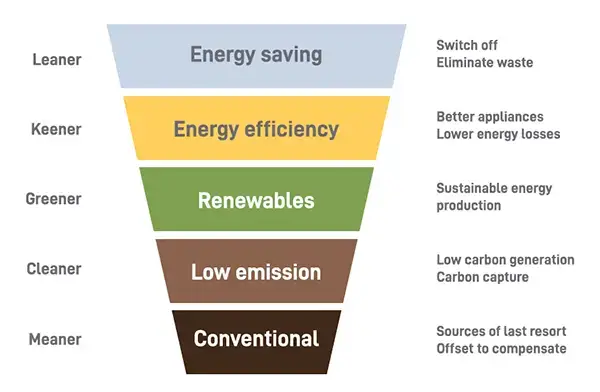
Energy efficiency measures include building fabric improvements (e.g. insulation, draught-proofing, double glazing), installing low energy (LED) lighting, using more energy-efficient appliances/machinery, lagging pipes and using smart devices to minimise energy use.
There are often further energy savings to be found by optimising existing gas/oil boilers, to cut hot water temperatures from 80oC to 60oC or by adding weather compensation in order for boilers to take into account weather conditions. Useful tips for a range of energy efficiency measures based on farm type can be found on the Farm Carbon Toolkit website and the Carbon Trust have a useful guide to Energy Efficiency in Agriculture. Some energy companies also outline a range of energy saving tips (e.g. Octopus Energy).
The high energy prices which characterised the winter of 2021-22 clearly illustrate that those who have taken energy efficiency measures before these energy market cost increases occurred are affected to a lesser extent and are therefore in a better financial position than those who have not. An energy-saving measure which may not appear to be very cost-effective in a time of low energy prices can make a big difference when prices go up, and it is worth understanding what that difference might be against a number of background energy price scenarios. A similar assessment should be made when considering a capital investment in a renewable energy installation.
In any case, the trend for energy prices has been upwards over the past 20 years, as shown in the chart. From a climate change perspective, it is notable that the smallest energy users perversely pay the greatest per unit cost and have also seen the largest price rise.
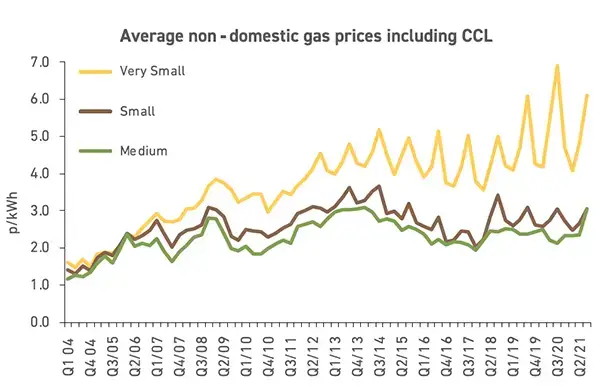
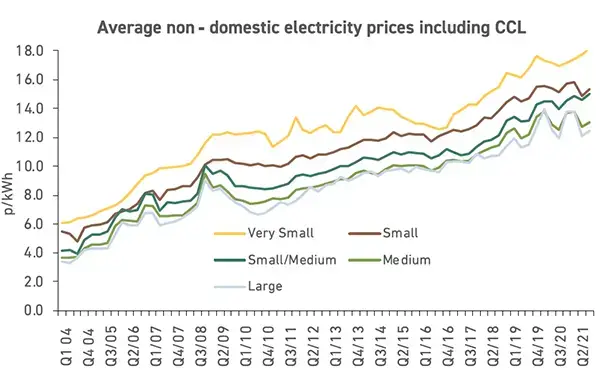
It is interesting to note that the useful asset life of many renewable energy systems, which may have offset some of this cost and cushioned food production businesses from energy price fluctuations, is in excess of this time frame. Such technologies, discussed below, are an important part of the range of decarbonisation tools that farm businesses can access.
There has been a general worldwide shift from coal to gas for energy production85 to reduce emissions of CO2 and air pollutants. It is unclear, however, whether the 2021-22 ‘perfect storm’ of high energy prices caused by a ‘Covid recovery’ demand growth for gas, a lower-than-expected supply, sub-average storage inventory and cold weather will continue.
According to the International Energy Agency, ‘the exceptionally high gas – and by extension electricity – prices … are likely to have a lasting negative impact beyond seasonal tension.
Nevertheless, the energy transition is happening as generation moves from centralised to decentralised systems with a commensurate shift from analogue to digital technologies. These conditions help to enable farm businesses to actively and easily manage their energy generation, consumption, carbon footprint and their bills.
Nearly four million, mainly rural, UK homes (15%) are not connected to the gas grid and therefore must use another energy source, generally oil, liquid petroleum gas (LPG), coal or electricity for heating and these have higher emissions than natural gas. Getting these homes onto low carbon heating is therefore disproportionately better than getting the same number of gas grid homes to switch.
The Climate Change Committee has noted that 8 out of a total 9 Mt CO2e of direct emissions in off-gas homes, oil and LPG-heated homes are responsible for 8 Mt CO2e. These ‘off gas’ homes, mainly situated in rural and peri-urban areas, make up a greater share of heating emissions (23%) due to the higher carbon intensity of oil and LPG compared to gas.
With nearly 20% of homes in rural areas in the lowest F and G energy efficiency bands (compared to just 2.4% in urban areas), the rural poor have to save proportionately more on their energy bill than their urban counterpart.
Defra considers that ‘around 50% of houses in the rural areas are ‘energy inefficient’ compared to 7% in urban areas’.
The Energy Savings Trust expressed this ‘double disadvantage’ of poor housing stock coupled with expensive off-grid heating thus: ‘the typical rural, fuel poor family would have to find a way to save over £600 a year on their energy bill before their energy costs become affordable. A typical fuel poor family living in town only has to achieve around £300 savings to reach an affordable level’. They add that only 40% of homes in rural areas have gas boilers (the cheapest heating option) compared to 91.1% of urban households.
One of the authors of this report carries out farm energy audits in preparation for renewable energy feasibility studies and has surprisingly often found that the biggest electricity use across the whole farm comes from the farmhouse itself – so its impact on the farm’s overall energy cost and carbon footprint should not be ignored.
A 2011 report by the ‘Future of Rural Energy England (FREE)’ project found a recurring theme which suggested that people on private rented accommodation were concerned about improving their homes, for fear of being subject to rent increases. A regional study found that they were also concerned about complaining about poor building fabric and heat to landlords (e.g. on tenanted estates) for fear of losing their home and their livelihoods.
Rural areas need higher installation rates of small-scale renewable technologies (e.g. solar thermal, biomass and heat pumps) for renewable heat in rural locations, and particularly for those off the gas grid.
Nevertheless, there are clear policy gaps that need to be addressed to enable rural homes and businesses (particularly those excluded from the gas grid) to utilise their own resources (wind, water, sun and biomass) to create energy, either individually or at a community level.