
by Jonathan Wheeler
Anaerobic Digestion (AD) is a biological process that converts organic matter into biogas and digestate. Applications include manure management, food waste treatment, agricultural residue valorisation, on-farm energy production and soil fertility enhancement.
Anaerobic digestion is the decomposition of organic materials (biomass) by microbial communities in the absence of oxygen. It is the process which over millennia created the natural gas which is core to the UK’s electricity and gas grids.
This process occurs naturally in places such as landfill sites, rice paddies, septic tanks and in slurry storage tanks, leading to uncontrolled emissions of biogas, which primarily consists of methane (known as biomethane) and carbon dioxide. Although anaerobic digestion occurs to a lesser or greater degree at a wide range of temperatures, AD plants require heat for the microbes to operate in an optimal fashion (typically 35-40ºc).
An AD plant captures the biogas and can then beneficially utilise it in of a number of ways: in a specially designed boiler for heat only, in a combined heat and power plant (CHP) to create electricity and heat, as vehicle fuel or directly injected into the gas grid. CHPs are usually connected to the electricity grid but can be used off grid in ‘island mode’ if there is enough energy use or storage on site.
If used as a vehicle fuel or injected into the gas grid, the carbon dioxide is normally stripped from the methane in a process known as upgrading. Some European countries allow small quantities of biogas to be injected into the gas grid without being upgraded, but UK rules require the addition of propane to the biomethane in order create a consistent calorific value for customers. The requirement to add fossil propane to this renewable gas for grid injection has been questioned and should be reviewed with some urgency.
The carbon dioxide produced from the upgrading process can also be used in a number of ways to offset industrial CO2 created by fossil fuels. These include greenhouse environment enrichment for improved plant growth, in abattoirs or, if upgraded to a high specification, for food and
beverage industry use (e.g. beer, cola, crumpets). As a mainly pure carbon source (unlike air at 400 ppm), it could even be ‘sequestered’ (pumped underground/undersea).
The output from AD plants is known as digestate and it is a fertiliser high in readily available nitrogen (RAN). It can be used ‘whole’ or separated into a liquid fraction and a solid fraction.
When incentivised by Pollution Control Grants in the 1990’s, AD plants were relatively small (with a capacity under 350 mº and suited to herds of ~350 dairy cows). They were installed as an advanced slurry/farm waste management and nutrient/organic carbon recycling system and, in many cases, the driver was odour control. Such digesters were regarded as another item of valuable farm equipment and not a major diversification activity. The biogas was used directly in Agas and Rayburn stoves, and robust cast iron boilers which lasted for many years.
© Photo: Lee Morphy/Stephen Parish
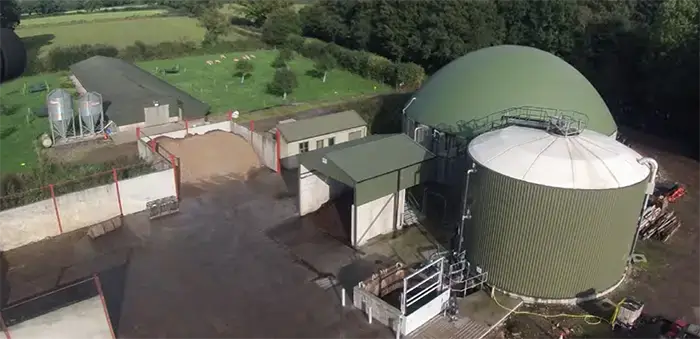
Small biogas plant on mixed sheep, dairy and free-range chicken farm
With the introduction of Renewable Obligation Certificates (ROCs) and the Feed-In Tariff (FIT) which followed the German model of incentivised electricity production via CHP, digester sizes increased, as did the proportion of purpose-grown crops (e.g. maize) required to feed them.
The resultant increased quantities of digestate require a larger land base to recycle nutrients back to, with a commensurate increase in transport distance and cost. The majority of farm AD plants built recently under the Renewable Heat Incentive (RHI) before it was suspended were even larger in order to justify the cost of upgrading gas-grid injection equipment and on some sites excluded farm residues.
It is predicted that AD plants built under the latest incentive, the Green Gas Support Scheme (GGSS), will be even larger due to the scheme structure and because the biomethane must be grid injected. Sustainability criteria were introduced or included in these latter schemes in order to minimise indirect land use change by limiting the amount of crop input. This offers further opportunities for minimising ‘waste miles’ by including local wastes (such as food waste) into farm AD, as long as appropriate biosecurity measures are followed.
It is perfectly feasible to utilise small upgrading systems to produce off (gas) grid biomethane for local use in biomethane tractors and farm delivery vehicles – or for a boiler or CHP. Such systems can be used to add value to large digesters or in smaller systems, thus removing the cost of gas injection and the propane supplementation equipment. If used in transport, biomethane attracts an incentive known as Renewable Transport Fuel Certificates (RTFC’s) and does not require propane addition.
An excellent resource for all aspects of biogas can be found in the IEA Task 37 brochures.
Case study
Sustainable Dairy Farming at Copys Green
More than 15 years ago, Stephen Temple began making steps to improve the sustainability of his dairy herd of dairy herd of 126 Brown Swiss dairy cows and their followers on his 230-hectare Norfolk farm.
He believes that sustainability is not just about the use of special technologies or techniques, it is about the whole approach to the farming operation, as well as attention to detail on each aspect. Quantification of the financial benefits of each measure has been difficult to quantify, but the dairy herd has moved from loss-making to being profitable.
His small 870 m3 anaerobic digester is fed with manures, low quality silage (leaving the best for the cows) and whey, with 70% of the electricity being exported from the 140 kWe CHP. The heat from the CHP is utilised to offset fossil fuel heating: for dairy hot water, cheesemaking, grain drying, 4 houses, office, workshop and cow drinking water. With 24/7 on-site energy production, the farm has gradually electrified: the 6-cylinder diesel pump is now an electric one; digestate is pumped to the field by underground mains to avoid road traffic; there are 3 electric farm cars, a ride-on mower, an electric Gator for herding cows and an electric loader for scraping out slurry.
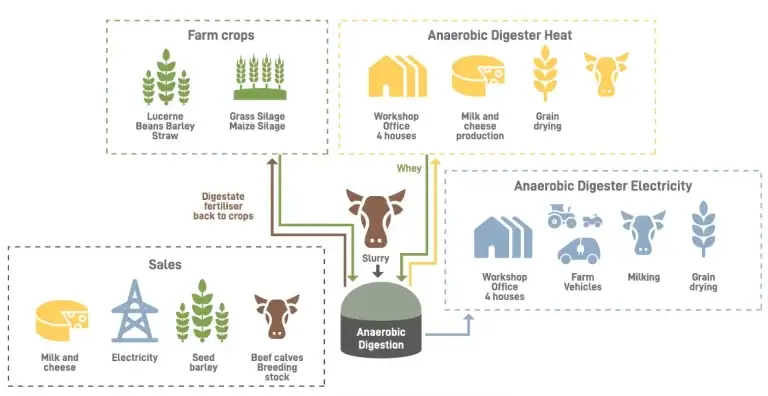
Integrated sustainability approach at Copys Green farm
A focus on a healthy, productive herd includes routine testing, vaccination where possible, reducing antibiotic use by utilising good bacteria (Pruex) in water and bedding to fight infectious bacteria, using outdoor calf hutches and, with a closed herd, breeding for longevity. Sexed semen is used on the best cows for replacement heifers and good beef semen for quality beef cross calves sold to a local rearer and fattener. As much feed as possible is grown on the farm, eliminating soya: lucerne for protein at low input levels; maize (experimentally grown with climbing beans) and grass silage, barley and beans.
The farm has worked closely with the Norfolk Rivers Trust to protect and enhance their chalk stream and with the Norfolk Wildlife Trust to improve the environment for wildlife, such as developing wildlife corridors between ponds.
Protection and improvement of soil structure through regenerative practices is a core principle: direct drilling and strip tillage in combination with cover crops and rotations to improve soil. Over a decade, Stephen developed a maize drilling system to strip till into cover crops. Digestate liquid is applied with trailing shoe to reduce ammonia losses and they are experimenting with acidifying the digestate to further reduce losses.
Further sustainability measures include reducing plastic by buying feed and feed supplements in bulk/1 tonne bags; eschewing wrapped bales for silage in favour of using a silage clamp; using straw bales to maximise volume stored under cover (and, unlike bale mesh, recycling the string); and washing udder cloths in an industrial washing machine instead of using disposable wipes.
There is a lot of trial and error that occurs in their sustainability journey and all at Copys Green Farm are generous with their time and knowledge, regularly hosting tours of farmers, schoolchildren and the general public.
Renewable Obligation Certificates (ROCs) are tradable certificates issued by the government to electricity generators who produce electricity from renewable energy as part of their Renewable Obligation (RO). The number of ROCs issued is based on the amount of renewable electricity generated, and they can be sold to energy suppliers who are required to meet renewable energy targets as part of a low carbon economy drive.