
It has been said that ‘farming is the art of turning fossil fuels into food’. However, a transition to a low carbon economy requires reducing food production reliance on fossil fuels as much as possible, as well as reducing other GHG emissions.
Although agriculture contributes only 0.5% to the UK economy, farmers and land managers take care of 71% of the land area and provide half the food we eat. Agriculture is responsible for around 10% of the UK’s CO2e emissions (45.4 Mt CO2e of 451 Mt CO2e in 2018).
Whilst the sector is responsible for only 1% of CO2e emissions (largely from energy and fuel), it is responsible for half of the UK’s total methane (CH4) emissions and 70% of the nitrous oxide (N2O) emissions. Grazing livestock are said to be responsible for 90% of CH4 emissions and nitrogen fertiliser for 90% of N2O emissions. These figures do not consider any offsets at farm level, for example, from low carbon or sequestration initiatives, but much still needs to be done.
Some farmers have chosen renewable energy generation as part of farm diversification enterprises. With 68% of farms using their resources to carry out non-agricultural activities (2019/20), 22% of farm business selected solar energy as a diversification option (see section 5.6 below), with 11% choosing ‘other’ sources of renewable energy, typically wind power and bioenergy (biomass, biofuels and biogas).
Many of the case studies in this document illustrate how the introduction of a single renewable energy technology acts as a gateway to further integrate complementary technologies and practices to reduce carbon emissions across the business (see Caerfai Farm, Copys Green Farm and Marsh Farm case studies).
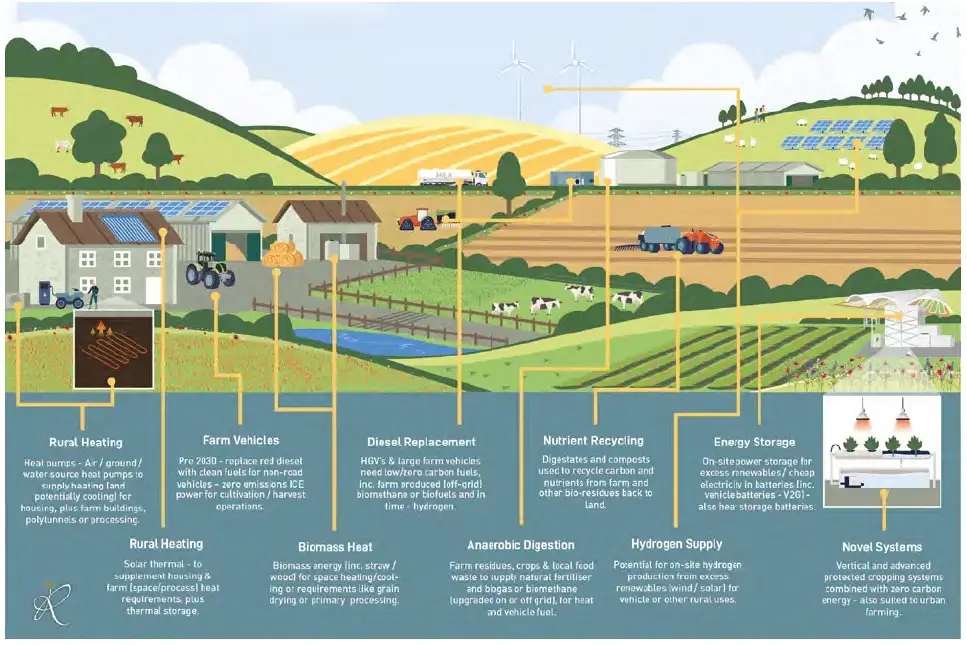
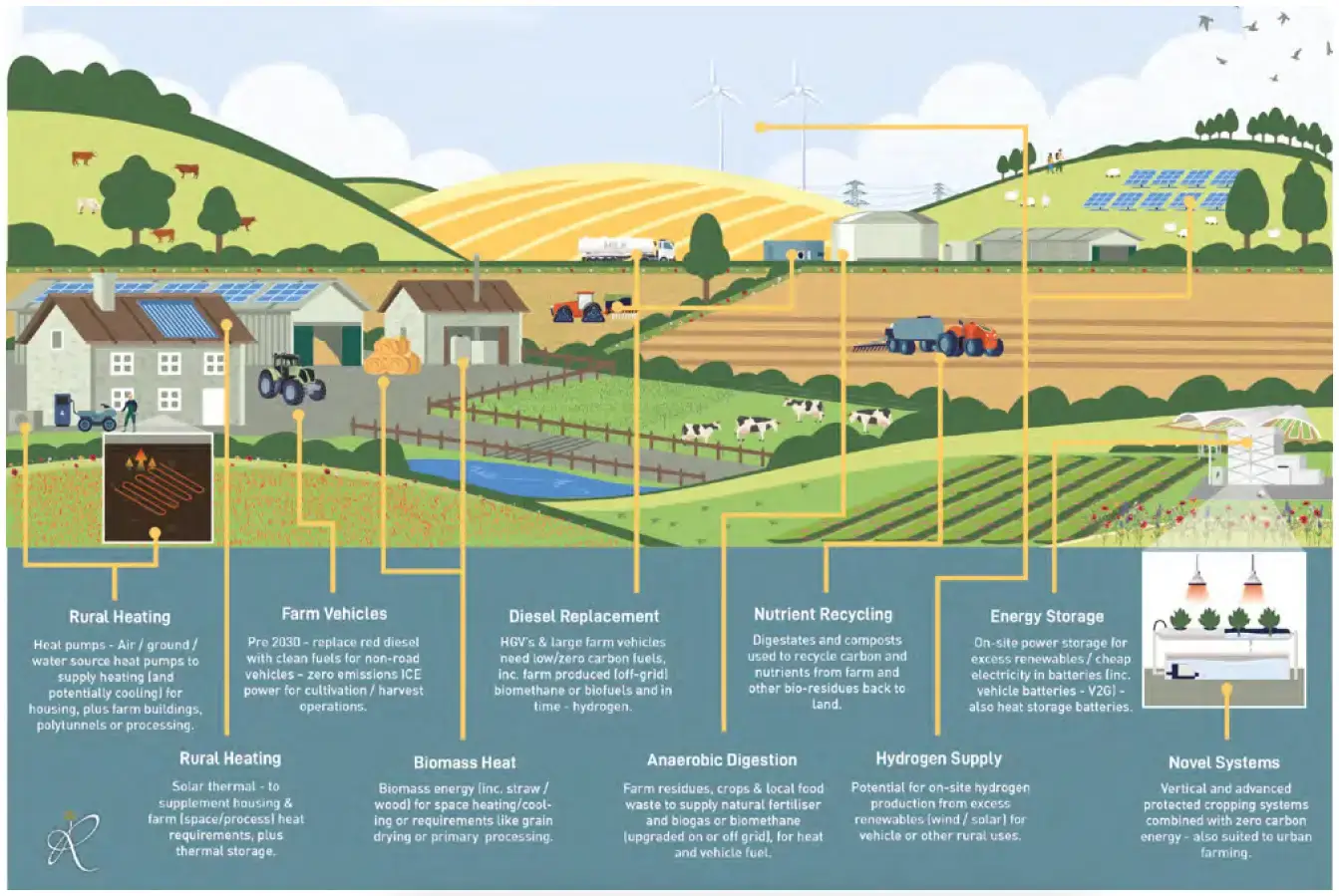
The addition of farm-level battery storage is becoming an increasingly attractive option as battery costs fall, particularly where intermittent renewable energy (e.g. from on-site wind/solar) is available and the farm’s electricity requirements justifies its use. With intermittent renewable energy production, matching energy use to energy production is essential. Energy storage of all kinds (e.g. battery; pumped storage hydropower (PSH); electrolysis) is an important part of being able to extend those hours of energy use.
On-farm low and zero carbon renewable energy
Heat pumps are likely to be an increasingly attractive option, in particular for heating properties not on the gas grid. Such installations require a thorough assessment of the building fabric, insulation and airtightness in order to size an installation properly. It is also perfectly possible to utilise heat pumps in older buildings (after a few basic measures have been taken) or to have a hybrid system which includes an LPG boiler and a heat pump.
Farm-scale anaerobic digestion (AD) (see section 5.4) based on livestock, local food waste and crop residues, particularly at small scale, has massive potential to provide 24/7 energy production which can be used flexibly for heat, electricity and transport fuels. Unlike other renewable energy systems, AD has further important non-energy benefits including fossil fertiliser replacement, weed seed reduction and improved animal health, with treated digestate spread on grazing land, replacing raw slurry. There is still a policy gap to support smaller systems, particularly for their environmental benefits on livestock farms.
Where a suitable watercourse is available, small hydropower projects can provide farms, communities and businesses with a non-intermittent supply of renewable electricity. As a rural resource, there needs to be on-going support for such projects. A number of these have also been built by community energy initiatives, providing wider rural benefits. The Renewable Energy Foundation FIT register shows that hydropower provides a contribution of 247.79 MW to the UK’s energy supply.
| Type | England | Scotland | Wales | Total |
|---|---|---|---|---|
| Domestic {.3-100kW] | 140 (1.95 MW) | 130 (2.19 MW) | 111 (1.50 MW) | 385 (5.79 MW) |
| Community [4-500kW] | 24 (0.85 MW) | 17 (2.15 MW) | 14 (0.79 MW) | 56 (4.29 MW) |
| Commercial [3-2253kW] | 134 (16.21 MW) | 383 (160.64 MW) | 153 (14.14 MW) | 736 (230.13 MW) |
Domestic, community and commercial UK hydro installations (and power) in receipt of FIT by country. Source: REF
Community energy initiatives such as those supported through the Rural Community Energy Fund (RCEF) need continued support to make important contributions in identifying and addressing specific rural community energy needs, particularly for those not connected to the mains gas grid or where housing stock is energy inefficient.
Community groups facilitate much more than just energy generation: they support skilled rural jobs, provide wider social benefit, act as a knowledge hub and engage people in a collective drive to net zero.
The integration of on-site energy systems, within the farm itself and as part of the grid is an exciting growth area, particularly with the development of smart devices and energy supplier tariff schemes which enables users to prioritise and automate energy use. This enables electricity from solar and small on-site wind turbines to be preferentially used on-site in a ‘cascading’ priority of uses (e.g. firstly for space heating, then to dairy hot water and finally to office hot water).
Electric vehicle charging systems will become a necessity as the transition to EVs progresses. Battery storage will better enable the utilisation of renewable energy for on-farm EV charging e.g. cars, vans, quad bikes and compact tractors. ‘Smart charging’ allows EVs to charge when grid electricity is at its cheapest, i.e. off-peak. The development of Vehicle-to-Grid technology (V2G) provides the opportunity for two-way charging to and from the EV and the battery or mains grid.
Renewable electricity can also be used (either directly or stored) to heat water for space heating and other farm uses, possibly supplemented with solar thermal panels or biomass boilers. If heating or cooling is an on-site priority, further options may include heat pumps and/or a ‘heat battery’ which uses phase change materials to store energy.
Heat recovery and ventilation systems offer further scope for potential energy savings. Such systems, for example, could be used to supplement the heat required to operate a small farm-scale anaerobic digester, which in turn can be used to provide heat and/or electrical energy for on-site use.
There is a clear policy gap which prevents rural homes and businesses – especially those off the gas grid – from using their own resources (wind, solar, thermal, water and biomass) to create their own energy, either individually or at a community level. This gap particularly applies to biogas (and off grid biomethane) production derived primarily from wasted local organic resources. However, policy should also include other biofuels such as bio-propane. All of these technologies can support rural decarbonisation, energy resilience and local jobs.